
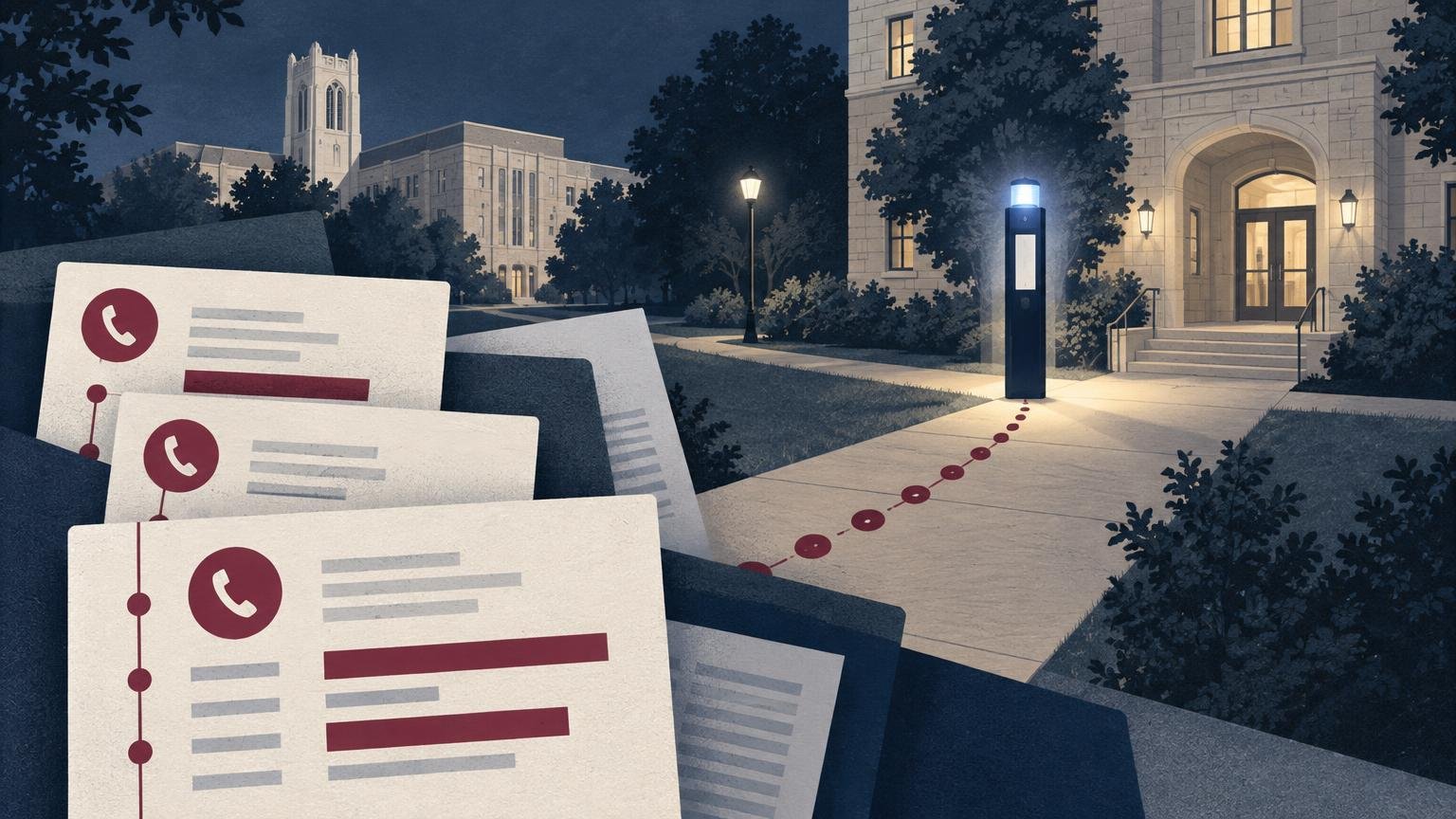
Lauren McCluskey repeatedly contacted University of Utah personnel during the 13 days before she was murdered on campus. She received some assistance: a security escort, conversations with officers and an extortion investigation. But the record also shows information that was not entered into police systems, weaknesses in checking an identified suspect’s background, fragmented coordination and a threat-assessment process that did not bring the known facts together.
This Lauren McCluskey University Utah response timeline separates what officials knew and did in October 2018 from what later reviews uncovered. That distinction matters. The evidence does not establish that one missed referral, records check or police action would certainly have prevented her murder. It does establish that McCluskey sought help while the danger was escalating and that the university’s systems did not handle the accumulating information adequately.
How to read the record
Four kinds of evidence shape this account. The first consists of contemporaneous calls, police reports, emails and recorded actions. The second is a review commissioned by the university and conducted by an outside team after McCluskey’s death. The third covers the university’s reform announcements and its 2020 civil settlement with McCluskey’s parents. The fourth is later oversight, particularly a 2022 state performance audit that tested the claim that reporting and coordination had improved.
These records do not all carry the same weight. The outside team’s review drew on interviews, police reports, dispatch recordings, video, policies and other documents. It was independently staffed, but the university commissioned it, and it was not a court judgment. The settlement resolved civil claims through negotiation rather than a jury verdict. University implementation reports document actions and commitments, but they do not by themselves prove that every reform worked.
Lauren McCluskey University Utah response timeline
October 9: McCluskey ended the relationship
McCluskey, a 21-year-old University of Utah track athlete, ended her relationship with Melvin Shawn Rowland on October 9, 2018. According to the university’s timeline, she had learned that he concealed his identity and age and that he was a registered sex offender. The supplied record does not identify a request for university intervention that day. That makes October 9 the beginning of the escalating personal danger, not yet the beginning of the documented university response.
October 10: An escort was provided, but the contact was not recorded
On October 10, McCluskey’s mother contacted University Police dispatch about obtaining a safety escort while her daughter retrieved her car. A campus security escort assisted McCluskey. The response therefore was not nothing: a university employee helped her complete the immediate task. But the later review found that the contact was not entered into the police records system.
That omission had consequences beyond paperwork. A record can make an earlier request visible when another officer evaluates a later complaint. Without it, the next employee may see an isolated event rather than part of a developing pattern. The failure here was not the absence of any assistance on October 10; it was the loss of information that could have helped the institution recognize escalation.
October 12: She reported messages that appeared designed to lure her
On October 12, McCluskey reported messages claiming that Rowland was dead and blaming her. The university’s timeline says she told an officer that she did not feel directly threatened, but believed the messages were intended to lure her somewhere. That distinction should be preserved: she did not report an explicit death threat during this contact, but she did report suspicious behavior connected to the man whose deception she had recently discovered.
An effective assessment does not depend only on whether a caller uses the word “threat.” It considers behavior, context and change over time. McCluskey’s description added another relevant event to the sequence. The institutional question is whether the university had a process capable of joining it to the escort request and the information that came next.
October 13: The case became an extortion report
On October 13, McCluskey reported blackmail or extortion involving intimate images. She identified Rowland as a possible suspect and said she had sent $1,000. At this point, University Police had more than a vague concern about a former boyfriend: officers had a named possible suspect, a reported financial payment and an allegation involving coercive use of intimate material.
The outside review later identified shortcomings in the process for obtaining and acting on offender information after a suspect was named. That is a later finding, not proof that every officer involved possessed Rowland’s complete history on October 13. It does show that the institution’s procedures were inadequate for turning an identified suspect into a timely, shared assessment of risk.
The review did not determine the detailed progress of the criminal extortion investigation. It therefore cannot support a definitive claim that investigators could have obtained an arrest warrant before McCluskey was killed. The responsible conclusion is narrower: the university had actionable allegations and an identified possible suspect, while its information-gathering and coordination systems had deficiencies later documented by its own commissioned reviewers.
October 19 to 22: An investigation opened as the warning signs continued
The university’s initial timeline says a formal extortion investigation began on October 19. A detective contacted McCluskey seeking more information, possible suspects and material that might support warrant work. The available review did not settle how far that investigation progressed, so the existence of an open case should not be confused with evidence that the risk had been fully assessed or contained.
Campus security video was later found to show Rowland on campus between October 19 and October 22. The available evidence does not establish that university personnel saw or acted on that footage in real time. It belongs in the retrospective record, but it should not be rewritten as knowledge officials demonstrably possessed before the killing.
At 10:39 a.m. on October 22, McCluskey emailed police about a text message that appeared to come from Deputy Chief Rick McLenon and asked her to go to the police station. The university later concluded that the text likely came from Rowland and was intended to draw her out of her residence hall. The episode added impersonation of a police official to the conduct already reported.
October 22 evening: The emergency response began
That evening, McCluskey was confronted in the residence-hall parking area while speaking with her mother by phone. She was forced into a car and shot. Dispatch received an emergency call from her father, officers responded, and police found her body at 9:55 p.m. The campus alert process began at 9:56 p.m.
The immediate emergency response must be evaluated separately from the handling of her earlier reports. A rapid alert after officers found her could not repair failures in records, coordination, suspect checks or threat assessment during the preceding days. The accountability issue is not only how police responded after the shooting. It is what the institution did with the information McCluskey provided before it.
What the 2018 review found—and what it did not decide
The university announced an outside review team to examine the actions of University Police and Housing and Residential Education. The resulting December 2018 report identified shortcomings involving offender-information checks, coordination between units, housing procedures, threat assessment, recordkeeping and victim-support infrastructure.
Those findings reveal a systems problem rather than one misplaced document. McCluskey’s contacts crossed dispatch, security, patrol, investigation and housing-related functions. Each contact could appear limited when viewed alone. A functioning safety system should preserve those contacts, route them to the right people and reassess risk as new facts arrive.
The review’s limits are equally important. It did not determine the detailed progress of the extortion investigation or resolve whether an arrest warrant could have been obtained in time. It was not a criminal prosecution, civil verdict or disciplinary adjudication. Its strongest contribution was identifying operational weaknesses against the university’s own records and procedures—not proving a single counterfactual account of what would have happened if one employee had acted differently.
Readers assessing any university-commissioned inquiry should ask who selected the investigators, what evidence they could obtain, whether findings were published and who was assigned to implement recommendations. Those questions are developed further in this guide to evaluating university investigations. In the McCluskey case, publication of the review created a baseline against which later promises could be tested.
The university promised changes in December 2018
The University of Utah accepted the review’s recommendations and announced actions that included additional staffing, lethality-assessment training, streamlined reporting, procedures for checking offender information, evaluation of police records systems and improved communication. These commitments addressed several weaknesses the review had identified.
A commitment, however, is an input rather than an outcome. Hiring staff or revising a protocol can be documented immediately. Whether housing information reaches police promptly, whether officers can see a complete history and whether students receive coordinated support require later operational evidence. The more persuasive measure is not how many recommendations an institution says it accepted, but whether subsequent testing finds that the underlying failure has stopped.
The 2020 settlement changed the university’s language and obligations
In October 2020, the university and McCluskey’s parents announced a settlement resolving the family’s civil claims. The agreement described McCluskey’s murder as a “preventable tragedy.” That acknowledgment was significant, but it arose through a negotiated settlement rather than a jury finding of liability.
The settlement provided for a $10.5 million payment by Utah’s risk-management agency or insurer and a $3 million university donation to the Lauren McCluskey Foundation. It also included renaming the university’s violence-prevention center for McCluskey and terms for an indoor track facility honoring her.
The McCluskey Center for Violence Prevention Research and Education states that it launched in September 2020, was renamed under the settlement and continues research and education concerning sexual violence among college students. That is evidence of an operating institutional program, although the center’s existence does not itself demonstrate that police and housing coordination problems were corrected.
The indoor track commitment remains governed by the settlement’s terms. The university’s giving page said it was developing plans for an indoor practice facility and track, while the agreement set December 31, 2030, as the stated deadline under its fundraising provisions. The materials in this record do not establish completed construction, final siting or full fundraising.
A 2022 state audit found that central problems persisted
The clearest test of the university’s reform narrative came from the Utah Legislative Auditor General. Its 2022 performance audit found continuing safety-reporting weaknesses, including housing-originated information that did not always reach University Police promptly and reporting pathways that were numerous and unclear. Readers can examine the official legislative performance audit directly.
The audit matters because it examined operations years after the review and initial reform announcements. It showed that accepting recommendations and announcing new procedures did not amount to proof that information consistently reached the people responsible for acting on it. Independent local reporting similarly emphasized that problems identified after McCluskey’s murder had not all been fixed.
This later evidence complicates any uncomplicated success story. The university could point to staffing, training, reporting changes and new violence-prevention work. The state audit could still find weaknesses in the movement of safety information—the same broad category of failure that made the October 2018 sequence so consequential.
What the timeline establishes
The record supports a firm but careful conclusion. McCluskey reported a series of escalating events: concern serious enough to request an escort, suspicious messages, extortion involving intimate images, a named possible suspect and a spoofed message impersonating a police official. University personnel responded to individual contacts, but the institution did not reliably preserve, connect and escalate the information across its systems.
The later review documented deficiencies; the university accepted recommendations; and the settlement called the murder a preventable tragedy while imposing financial and institutional obligations. Yet the 2022 audit found that important reporting and coordination weaknesses persisted. Reform therefore cannot be measured only by statements, renamed programs or completed training. It must be measured by whether information reaches the right unit, produces a documented assessment and prompts accountable action.
For students and families, the practical question after a serious report is not simply whether someone answered the phone. Ask for an incident or case number, identify which office owns the next step, document new contacts in writing and ask whether the information has been referred for threat assessment or coordinated support. Those steps cannot transfer responsibility away from the institution, but they can make gaps harder to conceal.
For the University of Utah, the unfinished accountability question is more demanding: can it show through independent testing that police, housing and victim-support systems now share and act on escalating information reliably? Lauren McCluskey asked for help. The record shows that the university heard separate parts of what was happening. Its failure was that the system did not assemble those parts into an adequate response before time ran out.
References
- Timeline of events in Lauren McCluskey case – @theU
- Audio files in Lauren McCluskey case – @theU
- d26toa8f6ahusa.cloudfront.net
- attheu.utah.edu
- Actions to improve campus safety and security – @theU
- d26toa8f6ahusa.cloudfront.net
- University of Utah and parents of Lauren McCluskey announce settlement agreement – @theU
- Microsoft Word – Final Report
- Annual Report – McCluskey Center for Violence Prevention Research & Education – The University of Utah
- Indoor Track & Field Honoring Lauren McCluskey – University of Utah Giving
- Audit finds University of Utah policing issues during McCluskey murder haven’t been fixed | KUER