
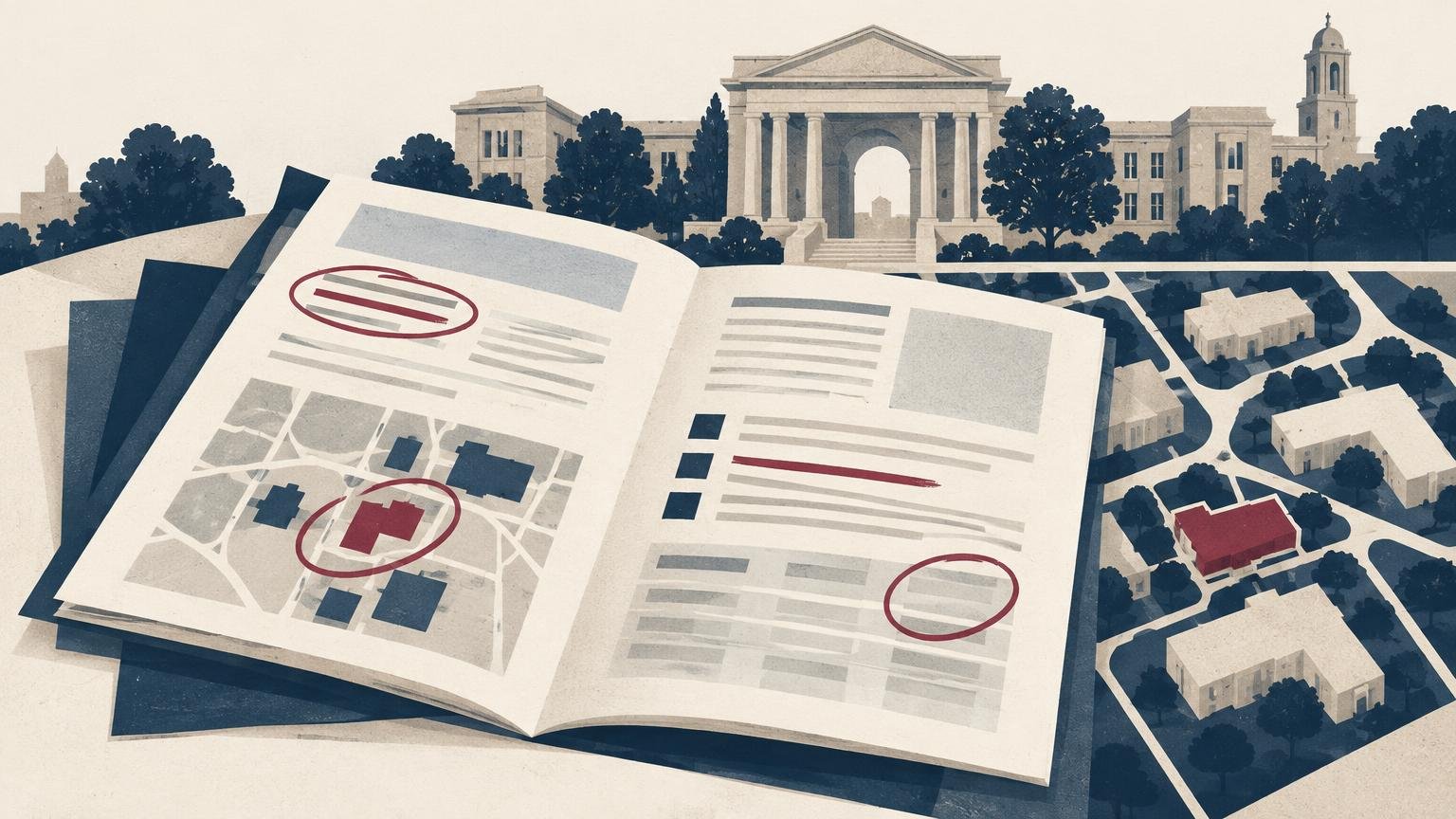
A college’s Annual Security Report can tell you which crimes were reported within defined locations, what safety policies the institution publishes, and how its stated response systems are supposed to work. It cannot tell you, by itself, whether a campus is safe or whether officials followed those policies in a particular case. That distinction is the starting point for anyone learning how to read college annual security report data.
Read the report as a bounded institutional record, not a safety scorecard. First establish the publication date, statistical years and covered locations. Then examine individual offense categories and policy commitments. Finally, test the report against more current records and direct questions. The useful inquiry is not merely how many incidents appear in a table. It is what the college was required to record, what remained outside that record, what officials promised to do, and what evidence shows they did it.
Find the report—and make sure it is the right one
Start on the college’s campus safety, Clery compliance, consumer information or police department website. Search for “Annual Security Report,” “Annual Security and Fire Safety Report” or “Clery report” alongside the institution’s name. Do not assume that the first PDF returned by a search engine is current.
Federal rules require participating institutions to publish and distribute an Annual Security Report by October 1. It must contain crime statistics for the three most recent calendar years as well as specified policy statements. The governing requirements appear in the federal campus security regulation.
Titles and cover years can be misleading. Texas Tech’s report page, for example, presents a 2026 report with statistics for calendar years 2023 through 2025 and separates information for multiple locations. The University of Maine at Augusta page identifies a document as a 2025 Annual Security Report while listing calendar years 2023 through 2025 and a September 29, 2026 publication date. These inconsistencies are a reason to inspect the document, not necessarily proof of a violation.
You can cross-check a school’s submitted safety and fire data with the Department of Education’s Campus Safety and Security Data Analysis Cutting Tool. The tool supports school lookups and comparisons, but it does not remove the need to read the institution’s geography definitions and policy language.
How to read a college annual security report in six passes
A long report becomes manageable when you read it in a fixed order. Use these six passes rather than moving from the first page to the last.
- Confirm the publication date, statistical years and covered campus or campuses.
- Find the Clery geography definitions and any accompanying map.
- Read the statistics by offense, year and location instead of relying on totals.
- Check the explanation of campus security authorities and reporting channels.
- Read the policies for warnings, emergencies, survivor support, discipline and prevention.
- Compare those promises with current crime logs, alerts, policy updates and answers from campus officials.
Read the geography before reading the numbers
Clery statistics do not cover every place where a student may experience harm. They are organized around defined geographic categories: on-campus property, qualifying noncampus property, and certain public property immediately adjacent to and accessible from campus. Institutions must also identify which on-campus incidents occurred in student housing facilities.
The categories sound broader than they may be. “On campus” generally concerns property the institution owns or controls within its campus boundaries. “Noncampus” can include certain institution-controlled locations and qualifying property used by officially recognized student organizations. The public-property category is limited to specified areas adjacent to campus; it is not a count of everything that happens in the surrounding town.
Look for a Clery geography map and a written explanation. Montana State’s 2025 report, for example, links to a geography map and notes that some private apartment buildings fall outside the policy and statistics coverage. An incident just outside a covered boundary may affect a student but never enter the institution’s Clery table.
Ask how the boundaries changed during the three displayed years. A college might acquire a building, close a satellite location, recognize a student organization that controls property, or add a program site. A changed count may partly reflect a changed reporting footprint. If two colleges define and operate very different physical environments, their raw totals are not equivalent measures.
Treat every number as a qualifying report, not a verdict
Annual reports disclose specified criminal offenses, Violence Against Women Act offenses, hate crimes, and certain arrests and disciplinary referrals. The tables usually divide those disclosures by year and geographic category. Read across one offense at a time. Note where it was reported, whether student housing is listed separately, and whether a footnote explains a revision or unusual entry.
A disclosed incident is not the same as a criminal conviction, campus disciplinary finding or verified investigative conclusion. Clery Center explains that the statistics reflect qualifying reports and should not be read as court, disciplinary or investigative outcomes. The University of Florida similarly states that qualifying reports are disclosed whether or not the allegations were investigated or substantiated.
That rule matters in both directions. A reader should not label every disclosed report a proven offense. A college also cannot fairly dismiss its own statistics on the ground that some reports did not lead to findings. The table answers a narrower question: how many qualifying reports were recorded for the listed offense, place and year?
Federal rules generally require a qualifying reported crime to remain in the statistics unless sworn or commissioned law enforcement fully investigates it and formally determines it was false or baseless. Institutions must disclose their totals of unfounded crimes. Review that figure, especially if it changes sharply, and ask who made the determinations. Do not treat “unfounded” as a casual synonym for unproven, uncharged or closed without discipline.
Why low numbers do not necessarily mean low harm
A zero or blank entry establishes only that the table contains no recorded qualifying reports for that category, year and geography. It does not establish that no student experienced the conduct. An incident may have occurred outside Clery geography, gone unreported, been reported through a channel that did not reach the institution’s collection process, or fallen outside the federal category’s definition.
A higher count is also ambiguous. It may reflect more underlying incidents, stronger awareness of reporting options, more accessible support, improved forwarding of reports by campus security authorities, a larger covered population, or expanded geography. The number alone cannot decide among those explanations.
This is why a simple “safest college” ranking built from raw Clery totals is unreliable. It can reward a weak reporting culture and penalize an institution where more people know how to report. The proper response is not to ignore the figures. It is to ask what system produced them.
Read policy statements as promises you can test
The policy sections explain what the institution says it will do. They can be more revealing than a university-wide total because they identify reporting routes, responsible offices, warning systems and available measures. But a written policy is not evidence that staff followed it consistently.
Examine who can receive a report and who must pass information into the Clery process. Look for the definition of a campus security authority, training responsibilities, anonymous or confidential options, local police relationships, and any limits on confidentiality. Determine whether a student can seek housing, academic or safety measures without first making a police report.
Then read the sections on timely warnings and emergency notifications. A timely warning concerns certain reported crimes considered a serious or continuing threat; emergency notifications serve a different function involving an immediate threat. Focus on who decides, what criteria guide the decision, how messages are distributed, and whether the policy says anything about withholding identifying details.
For sexual assault, dating violence, domestic violence and stalking, examine the reporting choices, supportive and protective measures, preservation-of-evidence information, disciplinary procedures, possible sanctions, appeal rights and prevention programs. The report should let a student identify what happens after asking for help—not merely state that the institution takes safety seriously.
Turn each policy into a verification question. If the report promises prompt warnings, ask to see prior warnings and learn how decisions are documented. If it promises training, ask who receives it, how often and how completion is tracked. If it promises prevention programs, ask what changed after recurring reports and how effectiveness is assessed. Institutional accountability begins where general policy language meets a named decision-maker, a deadline and an implementation record.
Pair the annual report with more current records
An Annual Security Report is retrospective. Even a newly published document contains tables for completed calendar years and may not capture a recent pattern. Pair it with records that show what has happened since the last statistical year.
Institutions with a campus police or security department must maintain a daily crime log. Entries generally must be made within two business days, and recent entries must be available for public inspection, subject to permitted exceptions. Ask where the log is posted, how to inspect it, and how to request entries outside the most recent period.
Also review timely warnings, emergency notifications, current safety policies and public statements about significant incidents. These materials serve different purposes and will not match line for line. Differences can still produce useful questions: Was a reported event outside Clery geography? Did officials decide there was no continuing threat? Was an entry delayed for a permitted reason? Did the institution later correct its federal submission?
Compare colleges without creating a false ranking
Responsible comparisons require matching the units being compared. Use the same offense category, calendar year and geographic category. Confirm that each table covers the campus a student would attend. Separate residence-hall figures where possible, and note major differences in enrollment, residential population, physical layout, satellite operations and covered properties.
Population context can help, but a calculated rate is not automatically a safety rating. Small counts can swing sharply from year to year, geography may differ, and reporting access affects what enters the record. Use three-year patterns to identify questions, not to pronounce one school safe and another dangerous.
When a figure changes, ask for the institution’s explanation and the evidence behind it. Did reporting channels change? Were campus security authorities retrained? Was a location added? Were past statistics corrected? Did officials identify a recurring location or organization, and what concrete action followed? These questions connect disclosure to responsibility.
A dated note about hazing disclosures
Hazing requirements are changing, so check the date of the guidance and the report in front of you. A Department of Education notice dated October 9, 2026 states that 2026 Annual Security Reports must include 2025 statistics for qualifying hazing incidents reported to a campus security authority or local police and occurring within Clery geography. The notice also addresses hazing policy, prevention and separate transparency-report requirements.
Do not confuse an Annual Security Report hazing statistic with a finding in a Campus Hazing Transparency Report. The first concerns qualifying reported incidents within the applicable statistical rules. The transparency report addresses organizations found responsible under the institution’s process, as described in the dated federal notice. Ask the college for both documents, their update dates, and an explanation of what standard places an event in each record.
Questions to bring on a campus visit
The most useful campus visit questions force officials to move from broad reassurance to identifiable systems and decisions. Ask the campus safety office, student affairs staff or admissions representative for specific documents or follow-up contacts when they cannot answer immediately.
- Can you show me the current Clery geography map and identify residence halls, adjacent public property, noncampus sites and excluded nearby housing?
- Which three calendar years appear in the newest report, and were any previously published statistics corrected?
- Who is designated as a campus security authority, and how does the college confirm that those people complete training and forward reports?
- Can students receive housing, academic or safety measures without making a police report or formal campus complaint?
- Who decides whether to issue a timely warning, and where can the public review past warnings?
- Where is the daily crime log, and how can someone inspect recent entries or request older ones?
- When reports recur in a residence hall, organization or location, who is responsible for changing conditions and measuring the result?
- What are the stated disciplinary timelines, possible sanctions, evidence standard and appeal options?
- Where is the Campus Hazing Transparency Report, and how does it differ from the hazing statistics in the Annual Security Report?
Use the report to sharpen the next question
The strongest reading of an Annual Security Report is neither credulous nor dismissive. The document provides required disclosures within specific years, categories and boundaries. Those limits do not make it useless; they define what the report can responsibly establish.
Begin with dates and geography. Read individual categories rather than totals. Keep reported incidents separate from criminal, civil and disciplinary outcomes. Treat policies as commitments that require evidence of implementation. Then use current logs, warnings and direct questions to examine what the college knew, what authority it had, what it chose to do, and what changed afterward.
Frequently Asked Questions
What should I check first in an Annual Security Report?
Record the publication date, the three statistical years, the campus or locations covered, and whether a newer report is available. Federal rules require statistics for the three most recent calendar years and specified policy statements.
Why should I review Clery geography before comparing crime numbers?
The statistics cover defined on-campus property, qualifying noncampus property, and certain immediately adjacent public property. Incidents outside those boundaries may not appear, so schools with different physical footprints are not directly comparable.
Does a low or zero count mean a campus is safe?
No. It means the table contains few or no qualifying reports for that offense, year, and geography. It does not account for incidents outside Clery geography or conduct that was not reported through the institution’s collection process.
Are reported incidents the same as proven offenses?
No. Clery statistics reflect qualifying reports, not criminal convictions, disciplinary findings, or verified investigative conclusions.
What current records should I review alongside the report?
Check the daily crime log, timely warnings, emergency notifications, current policies, and significant-incident statements. Institutions with campus police or security departments generally must enter incidents in the log within two business days and make recent entries available for public inspection, subject to permitted exceptions.
References
- eCFR :: 34 CFR 668.46 — Institutional security policies and crime statistics.
- Student Journalist FAQ
- Annual Security Report | Texas Tech Clery Compliance | Texas Tech
- Annual Security Report – University of Maine at Augusta
- ope.ed.gov
- 2025 Annual Security Report – 2025 Annual Security Report | Montana State University
- Institutional Reporting and Disclosure Requirements | 2026-2027 Federal Student Aid Handbook
- Clery — Compliance | University of Florida
- Changes to Campus Security Requirements Related to the Stop Campus Hazing Act | Knowledge Center