
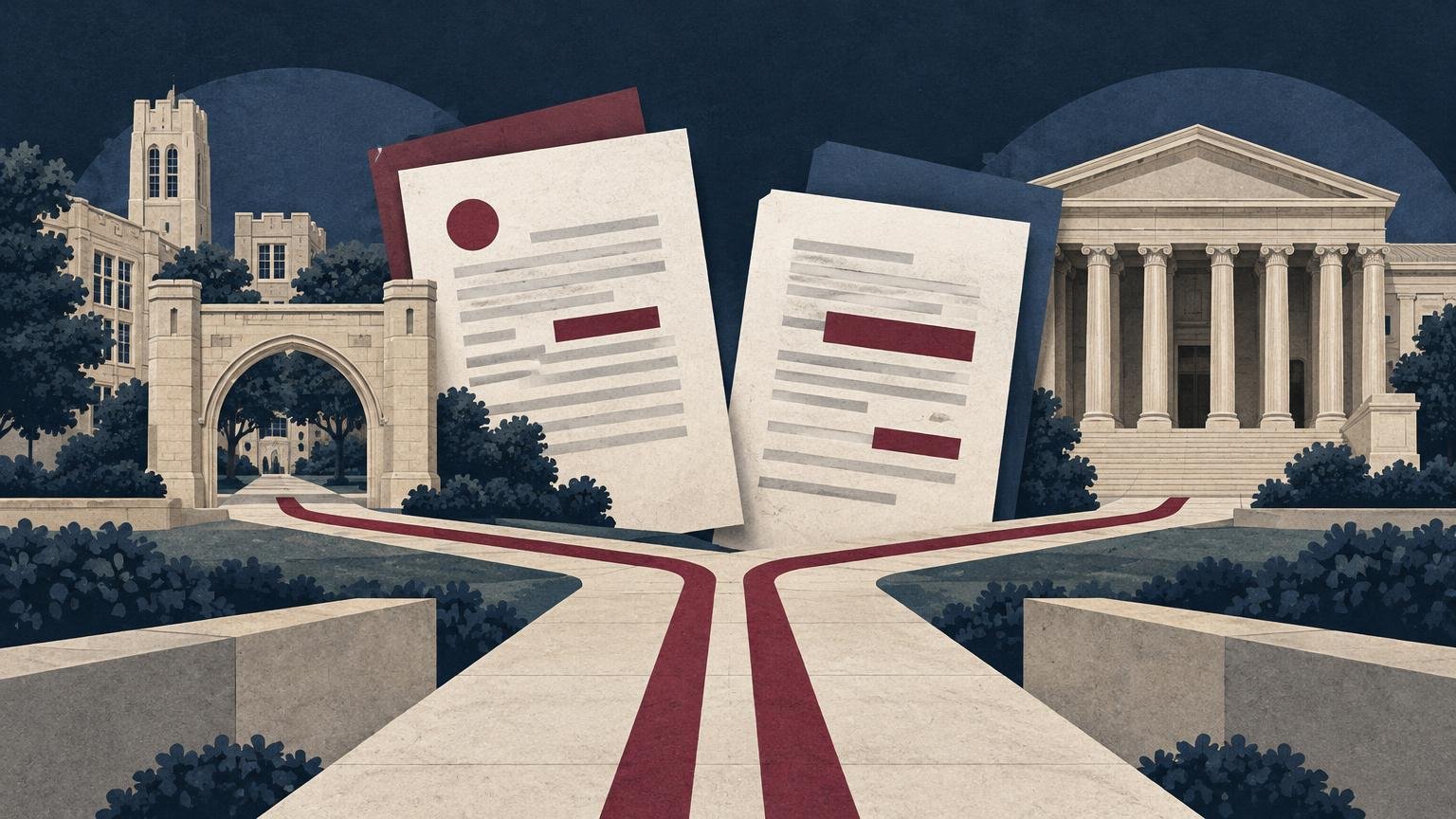
A campus no-contact directive and a court protective order can arise from the same reported conduct, but they belong to different systems. One is issued under a college’s administrative authority. The other is issued by a court under state law. They may restrict similar behavior, yet they differ in who can issue them, where they apply, how violations are reported, and what penalties may follow.
That distinction matters when a student needs immediate protection—or has been told to obey a restriction. A university directive does not automatically carry the enforcement powers of a court order. A court order does not automatically tell a university how to arrange housing, classes, dining access, employment, or student activities. In some cases, both may exist at once.
The terms also vary by institution, jurisdiction, case type, and document. “No-contact order,” “no-contact directive,” and “avoidance of contact directive” are institutional labels, not a single national rule. Protective-order categories and procedures likewise depend on state law. The actual written document controls.
A campus directive comes from institutional authority
A college may issue a no-contact directive through a student-conduct office, Title IX office, dean’s office, threat-assessment process, or another designated administrator. The measure can be used to reduce contact while a report is reviewed, prevent disruption, or support access to education. Depending on the school and circumstances, it may be mutual or one-way, temporary or continuing, and separate from any disciplinary case.
At the University of Virginia, for example, a No Contact Directive issued by the Office of Student Affairs’ PACE unit is generally bilateral and binds all named students. UVA describes it as an administrative measure following a report of a possible Standards of Conduct violation, not ordinarily as discipline or a presumption of responsibility. Its status changes if it is imposed as a sanction after a formal process.
Stanford similarly says its Title IX Coordinator may issue a temporary mutual no-contact directive between an accused student and a complainant as a supportive measure. Stanford states that the directive is not a determination of wrongdoing and that its duration depends on the circumstances.
These examples show why receiving a directive does not, by itself, establish that misconduct occurred. But that does not make the document optional. A university can treat noncompliance as a separate conduct violation even when the original allegation has not been resolved.
A protective order is issued through a court
A protective order—often called a restraining order in some jurisdictions—is a judicial order. The person seeking protection generally files through a court process established by state law. The available categories may depend on whether the alleged conduct involves domestic violence, stalking, harassment, abuse of an elder or dependent adult, workplace violence, or another legally defined relationship or act.
The California Courts guide to protective orders explains that a court order may prohibit contact, harassment, threats, stalking, or presence at specified locations. California’s categories and filing procedures are examples from one state, not a national template.
Virginia provides another jurisdiction-specific example. Its statutes authorize preliminary protective orders in family-abuse cases and make violations of specified protective-order provisions, including prohibited contact, a Class 1 misdemeanor. The Virginia statute on protective-order violations illustrates the central difference: violating qualifying terms can trigger criminal enforcement, not merely an internal university proceeding.
| Question | Campus no-contact directive | Court protective order |
|---|---|---|
| Who issues it? | An authorized university office or official under institutional policy. | A judge or court under applicable law. |
| What system governs it? | Student conduct, Title IX, employment, safety, or another campus administrative process. | State law, court rules, and the terms entered by the judge. |
| Does issuance prove wrongdoing? | Not necessarily; some directives are interim or supportive measures. | Not necessarily; the meaning depends on the type of order and procedural stage. |
| Where is a violation reported? | Usually to the office named in the directive; emergencies still go to 911 or campus/local police. | Usually to law enforcement and, where appropriate, the issuing court. |
| What can enforcement involve? | University investigation, conduct charges, access restrictions, or institutional sanctions. | Police response, court proceedings, and potentially criminal penalties under applicable law. |
| How is it changed? | Through the process and official identified by university policy or the directive. | Through the court; private agreement generally does not amend a judicial order. |
Read the prohibited conduct instead of relying on the label
The title of an order tells a student very little about its practical reach. The critical language is in the restrictions themselves. A document may prohibit direct conversations, calls, texts, email, social-media interaction, contact through friends, surveillance, threats, or approaching particular locations. It may contain exceptions for attorneys, formal proceedings, shared classes, approved exchanges of property, or emergency communication.
UVA’s published procedure, for example, says its standard directive bars direct and indirect contact, including electronic and social-media contact. Its general restriction applies to contact on university property, while its electronic and social-media provisions apply even when the parties are off campus. Any additional movement restriction must be written into the directive. That is UVA’s rule; another institution can define the scope differently.
Violations travel through different reporting routes
A suspected campus-directive violation normally goes to the university office identified in the document. At UVA, reports go to PACE, which may gather information. Noncompliance can lead to a Standards of Conduct charge, investigation, hearing, and sanctions. UVA separately instructs people in immediate danger to call 911.
A suspected protective-order violation generally belongs with law enforcement. Virginia court information advises a protected person to tell law enforcement when an order is disobeyed. California Courts tells a protected person seeking police enforcement of a restraining order to call 911. A student may also need to notify the university when the same event affects campus access or violates a separate institutional directive, but reporting to a college is not a substitute for contacting law enforcement when court-order enforcement or immediate safety is at issue.
Documentation can matter in either system. A student can preserve the order itself, messages, call logs, screenshots, dates, locations, witness names, incident numbers, and communications with university offices. Records should be kept without replying, escalating contact, trespassing, or taking another action prohibited by the document.
Both orders can operate at the same time
A university does not necessarily have to wait for a criminal charge, civil proceeding, or final disciplinary finding before taking an administrative safety measure. Under the current federal Title IX framework, supportive measures are distinct from disciplinary sanctions. Emergency removal is a separate step requiring an individualized safety-and-risk analysis, notice, and an immediate opportunity to challenge the removal. The U.S. Department of Education’s September 28, 2026 announcement states that the department rescinded the 2024 Title IX rule and reinstated the 2020 regulation.
At the same time, a person may seek a court order if the facts and state-law requirements support that route. UVA expressly recognizes that a protective order and a university directive can exist simultaneously. It tells each person to review and follow the particular conditions of both documents.
When the terms differ, the safer assumption is not that one cancels the other. A campus office cannot privately rewrite a judge’s order, and a court order does not silently erase an additional university restriction. Questions about conflicts should be directed promptly to the issuing university office and to qualified legal counsel or the court’s authorized assistance service, as appropriate.
A qualifying state or tribal protection order may also receive interstate enforcement under federal full-faith-and-credit rules. That potential reach is another reason not to treat a court order as though it applies only inside the county where it was issued. Its validity, duration, enforceability, and exact terms still require review of the order and applicable law.
What students should confirm immediately
- Who issued the document, under what policy or law, and on what date?
- Is the restriction one-way or mutual, and exactly who is named?
- Does it prohibit indirect contact through friends, organizations, or social media?
- Does it restrict access to residences, classes, workplaces, dining facilities, events, or other locations?
- When does it expire, and does it remain active during an appeal or review?
- Which office or law-enforcement agency receives violation reports?
- What process can modify, appeal, extend, or terminate it?
- How should unavoidable shared-campus situations be handled without violating the written terms?
Some timelines are short. UVA, for example, says a named student may appeal its directive within 48 hours and that the directive generally remains effective while the parties are in the university community unless it is modified or expires in writing. A student should check the applicable document immediately rather than assuming every campus offers the same deadline.
The institution’s responsibility does not end with issuing paper
A directive is only one part of a campus response. The university still has to explain its scope, identify a reporting route, address predictable conflicts in housing or classes, respond to reported violations, and avoid placing the full burden of implementation on the student seeking safety. Our account of Lauren McCluskey’s reports and the University of Utah’s response provides a separate case study in why reporting routes and institutional follow-through demand scrutiny.
The proper comparison is therefore not “which order is stronger?” in the abstract. The useful questions are who issued each document, what conduct it prohibits, where it applies, who enforces it, and what happens after a violation. A campus no-contact directive is an administrative tool. A court protective order is a judicial command. They can overlap, but neither should be mistaken for the other—and neither should be followed from memory when the written terms are available.
Frequently Asked Questions
Is a campus no-contact directive the same as a court protective order?
No. A campus directive is issued under institutional policy; a protective order is issued by a court under state law. They may restrict similar conduct, but their scope, reporting routes, and enforcement consequences differ.
Does receiving a campus no-contact directive mean the university found misconduct?
Not necessarily. UVA and Stanford describe directives that may be administrative or supportive measures rather than findings of wrongdoing, although a school may separately impose a no-contact restriction as a sanction after a conduct process.
Can a campus directive and a court protective order apply at the same time?
Yes. UVA expressly recognizes that both may operate simultaneously. Each document must be reviewed and followed because one does not automatically cancel or rewrite the other.
Where should a suspected violation be reported?
Report a campus-directive violation to the university office identified in the document. A suspected protective-order violation generally belongs with law enforcement; Virginia and California court guidance direct protected people to contact law enforcement or call 911 for enforcement.
What details should a student check in the actual order?
Confirm who issued it, who is covered, prohibited conduct, location restrictions, effective and expiration dates, exceptions, reporting routes, and the process for modification, appeal, extension, or termination. Do not assume a private agreement changes the written terms.
References
- Procedures for No Contact Directives and Appeals | Student Affairs
- Mutual No Contact Directives | Office of the Vice Provost for Institutional Equity, Access & Community
- Guide to Protective Orders | California Courts | Self Help Guide
- § 16.1-253.1. Preliminary protective orders in cases of family abuse; confidentiality
- § 16.1-253.2. Violation of provisions of protective orders; penalties
- What you Need to Know About Protective Orders
- selfhelp.courts.ca.gov
- U.S. Department of Education Formally Rescinds the Biden Administration’s Illegal Title IX Rewrite, Reinstating the 2020 Regulation | U.S. Department of Education
- www.ed.gov
- www.law.cornell.edu
- DV Brochure.2019.NDTX.07022019.Legal SizeBooklet_v08022019.pub